The Anatomy of an Evaluation: Auditing Digital Assets for Hidden Value

Digital platforms often underperform not because their core product is flawed, but because the user journey contains too much friction. When conversions plateau or retention drops, companies often jump straight to expensive redesigns. However, an audit of existing assets often reveals that significant value is already locked inside the current layout. Fixing these usability bottlenecks takes a clear method rather than guess-and-check adjustments. A structured expert review pinpoints interface failures, measures their impact, and helps recover that lost business value.
The Heuristic Framework
A heuristic review is an expert evaluation of a digital interface against established design principles. Unlike user testing, which watches how real people navigate a site, a heuristic audit relies on experienced UX specialists who evaluate the platform using proven behavioral models.

The baseline framework uses classic usability principles to look at elements like system status feedback, user control, consistency, and error prevention. For complex sites, specialists combine these basics with modern behavioral patterns, cognitive load measures, and accessibility standards.
The goal is to eliminate opinion from the review. Instead of asking if an interface looks good, the auditor asks if it fits how the target audience thinks. Every problem found links directly to a specific design rule, connecting interface bugs straight to user frustration.
Stage 1: Alignment and Context
An audit cannot happen in a vacuum. Before checking a single screen, the auditor needs a solid grasp of business goals and user intent. Without this context, a review risks flagging issues that are technically true but business-irrelevant.
This setup phase defines the primary conversion paths and core metrics. Whether the target is lowering cart abandonment, boosting course completions, or streamlining account setup, the audit has to match these priorities.
At the same time, the auditor builds out key user profiles and their main goals. Knowing the audience’s tech skills, real-world constraints, and expectations lets the reviewer look at the product through the right lens.
Stage 2: Mapping Pathways and Executing Tasks
With the boundaries set, the audit moves to mapping out pathways. The auditor walks through key user journeys, completing tasks step-by-step just as a real user would. This goes beyond looking at static designs; it tests dynamic transitions, feedback loops, and edge cases during live use.
During task runs, every step gets evaluated across a few core areas:
- Visual Hierarchy: Does the screen direct attention to the main action, or do competing elements clutter the layout?
- Interaction Effort: How many clicks, reads, and inputs does a task take? Do forms ask for repeated information?
- System Feedback: Does the system immediately confirm user actions so people know their input went through?
- Functional Reliability: How does the site handle mistakes? Are error messages clear and helpful, or do they leave users stuck?
Documenting these steps requires precise detail. Each issue gets logged with its exact location in the user flow, the rule it violates, and an initial estimate of how badly it blocks the user.
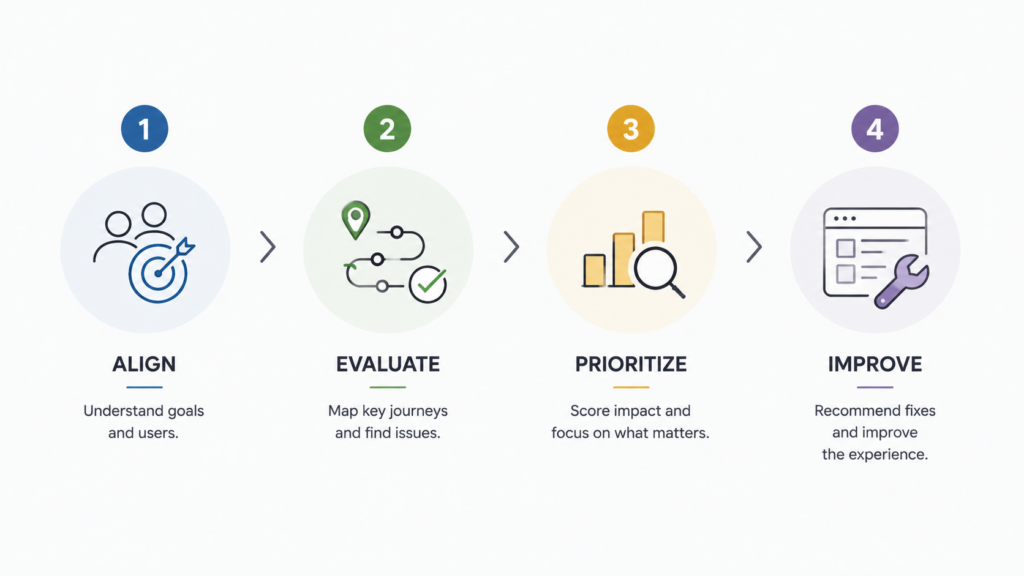
Stage 3: Severity Scoring and Prioritization
Not all design bugs carry the same weight. A misaligned footer link is very different from a broken checkout button. To make sure recommendations are easy to act on, issues get scored by severity across four levels:
- Blockers: Errors that stop task completion entirely, causing users to drop off or lose trust.
- Major Friction: Issues that slow users down or cause real confusion, even if finishing the task is still possible.
- Minor Flaws: Small design issues that create slight annoyance without derailing the user.
- Cosmetic Fixes: Quick polish opportunities in alignment, visual detail, or text that don’t directly affect task performance.
Combining severity ratings with estimated fix times creates a straightforward prioritization matrix. Product teams can tackle quick, high-impact fixes first before spending resources on larger structural changes.
Stage 4: Strategic Fixes and Synthesis
The final stage turns diagnostic findings into practical design updates. Finding a problem is only half the work; delivering a usable, scalable alternative creates actual value.
For every main issue, the auditor provides specific structural fixes. These range from adjusting small interactions and form rules to organizing page layouts and cleaning up inconsistent design components.
Instead of pushing for full-scale visual redesigns, good fixes target specific problems. By removing interface friction, clarifying navigation, and easing mental effort, companies can boost platform performance while protecting their existing software investment.

The Business Return of Usability Audits
An expert heuristic evaluation offers a reliable way to optimize digital products. By finding hidden friction points, businesses can turn underperforming sites into smooth experiences that satisfy users and hit business targets.
Choosing structured audits over guesswork keeps product decisions grounded in user data, psychology, and logic. Refining what you already have unlocks real value, maximizes ROI, and keeps digital products competitive.