Designing for the Modern Enterprise: Aligning B2B Platforms with B2C Expectations

For decades, business software was evaluated almost purely on technical capability, security compliance, and feature density. Visual clarity and intuitive interactions were secondary. Companies expected employees to take formal training, wade through thick manuals, and put up with clunky, multi-step navigation just to complete basic daily tasks.
That era is over. Today’s workforce uses consumer apps—like mobile banking and ride-sharing tools—that offer instant feedback, effortless navigation, and clear visual design. When people log into their work systems, their expectations don’t change. They don’t separate their habits as consumers from their roles as employees; they simply expect software to work smoothly.
This shift makes user experience a business necessity rather than a nice-to-have visual upgrade. Enterprise software that ignores modern usability standards risks low adoption, higher training costs, frequent user errors, and eventual replacement by faster, user-friendly competitors.
The Friction Gap: Managing Complexity
Bringing consumer-style ease to business platforms comes with a structural challenge: B2B systems handle enormous complexity. They process multi-layered permissions, stream large volumes of data, calculate complex financial logic, and support varied workflows across multiple departments.

The UX designer’s job isn’t to strip away these capabilities, but to manage them cleanly. Good platform design absorbs background friction so users never have to deal with it.
Instead of crowding every configuration toggle onto a single dashboard, modern platforms use progressive disclosure. They show only what’s necessary for the task at hand, keeping advanced controls easily accessible when needed.
Core Principles for Modern B2B Systems
To make complex business tools feel as natural as consumer software, product teams focus on a few architectural principles:
- Role-Based Views: Standard dashboards often clutter the screen with uncurated data. Information should adapt to who is looking at it. Executives need high-level metrics and system alerts, while operations staff need line-item details and actionable tools.
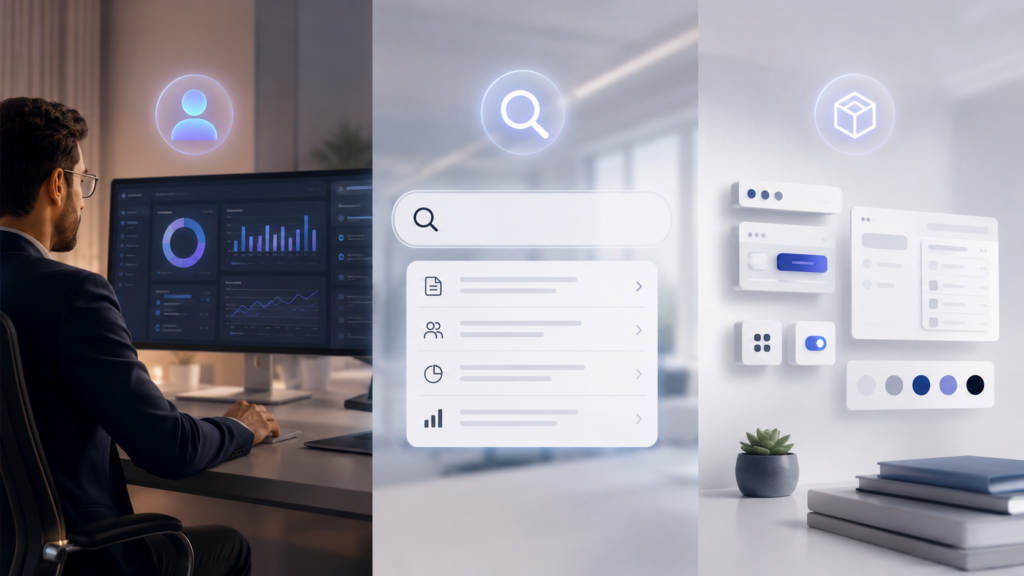
- Unified Search: Consumer apps rely heavily on fast, predictive search, and business software should too. Instead of clicking through nested menus to find a record, users should be able to type into a single search bar that understands intent, searches deep fields, and allows direct actions right from the results.
- Consistent Design Systems: As software grows or absorbs new products through acquisitions, the interface often becomes fragmented. A shared design system keeps buttons, menus, spatial layouts, and interaction patterns uniform across the platform. This cuts down on cognitive effort, as users can navigate new tools based on patterns they already know.
Grounding Design in Research
Building an intuitive system inside a complex industry takes research, not guesswork. Development relies on a practical three-part lifecycle:
- Discovery: Teams shadow users in their working environments and interview key stakeholders. Watching people perform daily tasks reveals real-world distractions, manual workarounds, and pain points that formal product requirements miss.
- Exploration: Concepts move from simple wireframes to interactive prototypes. Testing these prototypes helps teams refine navigation and workflows before engineers write production code.
- Validation: Usability is tested using clear metrics—like task completion rates, time spent, and error frequency. Testing the system in real working conditions keeps development on track and ensures the final product actually improves workflow speed.

The Business Case for Better B2B Software
Investing in enterprise user experience is often mislabeled as a cosmetic choice. In practice, thoughtful design delivers direct operational value:
- Faster Onboarding: Straightforward software lets new hires hit full productivity in days instead of months.
- Lower Support Costs: Clear design and human-readable error messages reduce internal IT tickets and vendor support requests.
- Fewer Operational Errors: Interfaces built around user focus reduce fatigue and manual entry mistakes, saving organizations from costly errors.
- Higher Customer Retention: For B2B vendors, consumer-grade usability directly improves renewal rates, grows account values, and cuts churn.
Companies that still view business software through a purely functional lens risk falling behind. By bringing B2B platforms up to modern B2C standards, forward-thinking organizations turn complex software from a daily headache into a genuine operational advantage.
Conclusion
The shift in B2B enterprise software is no longer a matter of preference—it is a fundamental restructuring of how business value is created and sustained. As the line between professional tools and daily consumer apps continues to blur, enterprises can no longer hide behind complex documentation or mandatory training to excuse friction-heavy software. Treating user experience as a luxury rather than a core requirement poses a direct threat to adoption, operational efficiency, and long-term retention.
Ultimately, winning B2B platforms will be those that respect the cognitive load of their users. By mastering the art of abstracting complexity through intelligent design systems, dynamic architectures, and continuous UX validation, organizations can turn dense workflows into seamless operations. In the modern corporate landscape, exceptional user experience is no longer just a superficial layer painted onto powerful backends—it is the primary driver of enterprise efficiency, user satisfaction, and sustainable competitive advantage.