Book a UX Call
Category

Category: AI in Design

AI in Design

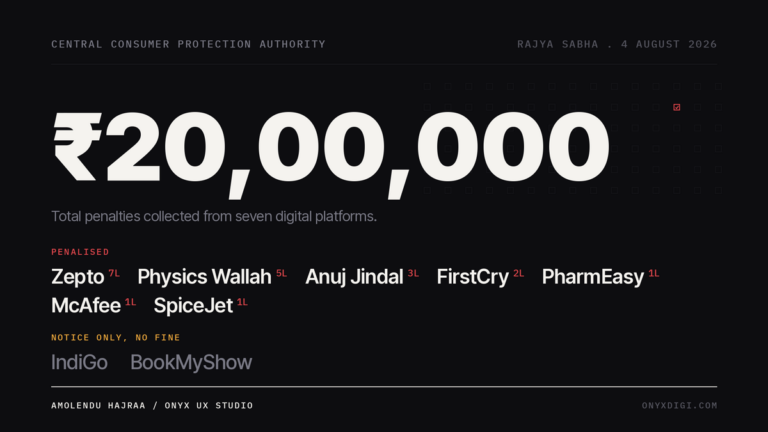
Twenty lakh rupees is what deception currently costs in India

August 12, 2026 7 min read

On 4 August, in a written reply to the Rajya Sabha, the Minister of State for Consumer Affairs put a number on India's first real enforcement drive against dark patterns. Twenty lakh rupees. Split across seven companies. That is about twenty three thousand dollars, which is less than most of those companies spend on a single week of performance marketing. I want to start with a correction, because the headlines got this wrong and I would rather be accurate than fast. Nine platforms were named in that reply. Seven were fined. Two of them, IndiGo and BookMyShow, received notices, fixed their screens, and paid nothing. The version that travelled across timelines was "nine platforms penalised." That is not what happened, and the difference matters if you are one of the two.

Read article →


UX

Scaling Digital Products: The Power of Research-Driven Prototyping and Engineering

July 23, 2026 5 min read

Building a market-leading digital product requires more than a single great idea; it demands an integrated execution framework. This article explores the core pillars of digital product strategy and the end-to-end UX design process, moving systematically from deep user research through rapid MVP prototyping to disciplined engineering. Discover how modern teams leverage AI-native product design workflows without losing senior product judgment, helping founders build category-defining solutions rather than just competing in a crowded digital market.

Read article →
Visual Design

The Evolution of E-Commerce: Adapting to Changing Consumer Paradigms

July 2, 2026 3 min read

The digital commerce landscape has transitioned from a basic transactional framework to a highly sophisticated ecosystem driven by intent-based navigation, architectural speed, and agentic commerce, where automated systems frequently evaluate platforms on behalf of users. Businesses failing to adapt to these structural shifts risk immediate obsolescence. This assessment details the precise interface modernizations required to maintain a distinct competitive advantage.

Read article →
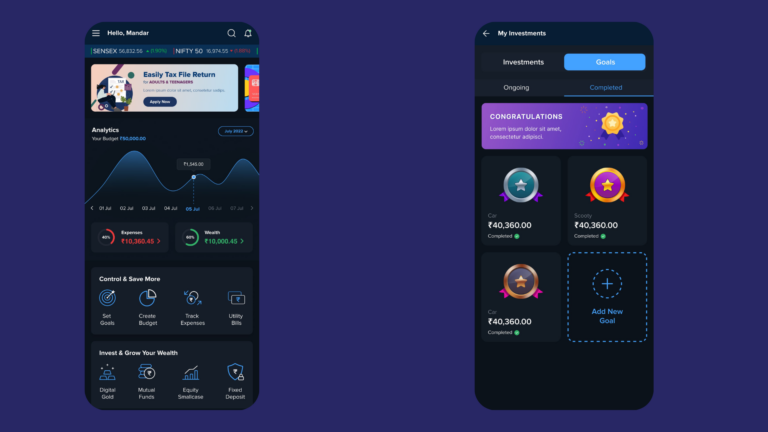
Two mobile app screens showcasing a dark-themed fintech interface side-by-side. The left screen displays a comprehensive home dashboard featuring a market ticker, a promotional banner for tax filing, a dynamic line chart for budget analytics, expense versus wealth tracking rings, and categorized quick-action icons for budgeting and investing. The right screen presents a 'My Investments' interface focused on the 'Goals' tab, displaying a celebratory banner and gamified achievement badges—such as bronze, silver, and gold medals—for completed financial milestones like purchasing a car and a scooty, along with a dashed card to add a new goal.
Arabic UX

Why FinTech UX Design Is the Real Key to Faster SAMA & DFSA Approval

June 20, 2026 4 min read

The perceived trade-off between regulatory compliance and user conversion is a myth that frequently stalls product launches. Treating regulations as an afterthought often leads to rejected designs and rebuilt KYC flows, stretching launch timelines from three months to nearly a year. However, by adopting a regulatory-native approach to FinTech UX design, founders can embed pre-vetted compliance patterns from day one, accelerating approvals from bodies like SAMA and the DFSA to just 2–3 weeks. This strategy is especially critical in GCC markets, where an Arabic-first localization process and clear, Shariah-compliant interfaces turn upfront disclosures into powerful trust signals rather than points of friction. Ultimately, designing for transparency proves that regulatory requirements are actually growth levers, with real-world data showing that clear, progressive disclosures significantly boost user engagement and conversion rates.

Read article →
A professional team at collaborates around a large interactive digital touch table displaying mobile interface prototypes, referencing whiteboards with user experience wireframes in a modern office.
UX

High-Fidelity Prototyping: Eliminating Ambiguity in Software Engineering

June 9, 2026 2 min read

Relying on static documentation during software development introduces ambiguity, resulting in costly technical debt and project delays. Onyx UX Studio mitigates these structural risks by employing a rigorous, design-first methodology centred on high-fidelity prototyping. By translating abstract stakeholder requirements into precise, interactive simulations prior to coding, the studio establishes a definitive technical blueprint. This analytical approach validates architectural feasibility, eliminates engineering guesswork across complex sectors like FinTech and EdTech, and protects capital investments. Ultimately, interactive prototyping ensures total cross-functional alignment, accelerating time-to-market whilst delivering scalable, secure, and highly validated digital products.

Read article →

Latest from the Onyx UX Blog

View all articles →