Hourly Billing Is Dead — Charge for Judgement
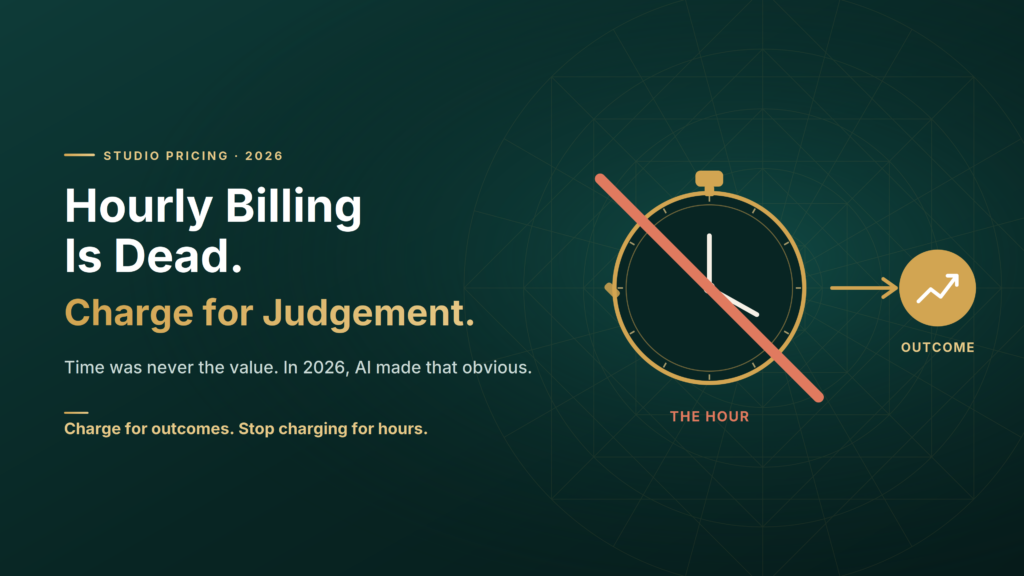
A hot take to end the week, and I mean every word of it: if your studio is still charging by the hour in 2026, you’re charging for the wrong thing.
Let me show you the math that breaks the model — because it’s the same math sitting quietly inside every agency that hasn’t dealt with it yet.
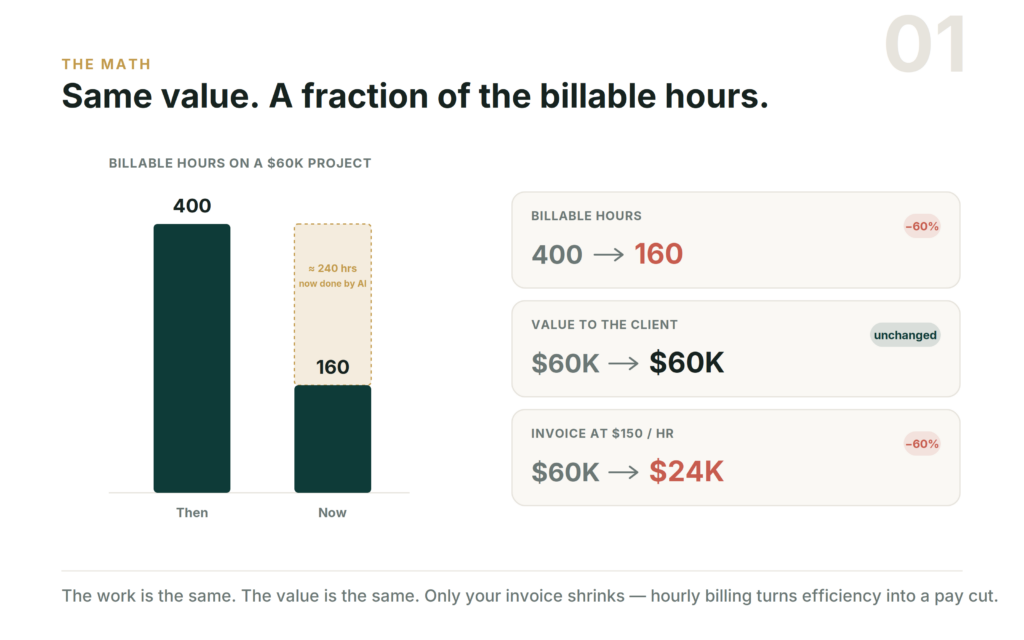
The old way looked clean. A senior designer at $150 an hour, times 400 hours, equals a $60,000 project. Everyone understood it. The client knew what they were paying for, you knew what you were delivering, and time was the unit. Time was even honest, because time was genuinely the thing producing the work.
Then AI walked into the studio.
Now AI handles maybe 60% of those 400 hours in around 40. The research synthesis, the first-pass wireframes, the copy variants, the repetitive screens — work that used to eat weeks now takes an afternoon. Which leaves you, the studio owner, staring at three doors. None of them is comfortable.
(a) You bill the client for 160 hours instead of 400. You’re honest — and your revenue collapses by 60% overnight.
(b) You keep billing 400 hours for 160 hours of work. Your revenue holds — and you’re lying to your client.
(c) You stop selling hours altogether. Fixed-price, scoped packages. You bill for the outcome, not the clock.
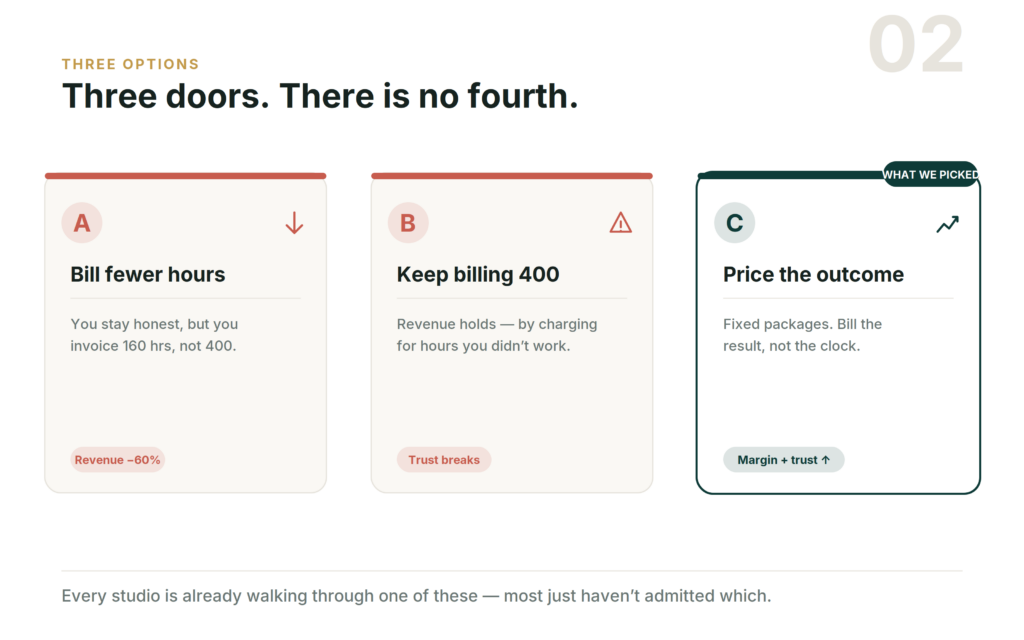
There’s no fourth door. Every studio is walking through one of these whether they’ve admitted it or not — and the ones quietly choosing (b) are the ones who’ll get found out first.
We picked (c) two years ago.
What we actually changed
Four fixed packages. A clear quote within 24 hours. No hourly rate anywhere on the proposal. No timesheets. No timesheet theatre — that awkward ritual where a team logs hours to justify a number that was really decided by value, not by minutes.
A client comes to us with a problem: a checkout that leaks revenue, an onboarding flow that loses people, a product that needs a design system before it can scale. We scope the outcome, name a fixed price, and own the path to getting there. How long it takes us is our problem to manage — not theirs to audit.
Two things happened, and the cleanness of the effect surprised even me.
Our margins went up. AI compressed the time, but the value didn’t move an inch. A checkout that converts 40% better is worth exactly what it was worth before, whether it took six weeks or six days to build. Price the outcome, and efficiency flows into your margin instead of leaking out of your invoice.
Our clients trusted us more. The moment the hourly meter disappeared, so did the quiet suspicion that we were padding the sheet. Nobody lies awake wondering if the agency stretched a two-hour task into five. The price is the price. The relationship stopped being adversarial and became a partnership.
Hourly billing was always a hack
Here’s the uncomfortable truth underneath all of it. Hourly billing was never a principle — it was a proxy. It worked for exactly one reason: human time used to be the bottleneck. When a senior designer’s hours were the scarce, expensive input that produced the result, charging for those hours was a reasonable stand-in for charging for the value.
That era is over. Human time is no longer the bottleneck.
Judgement is.
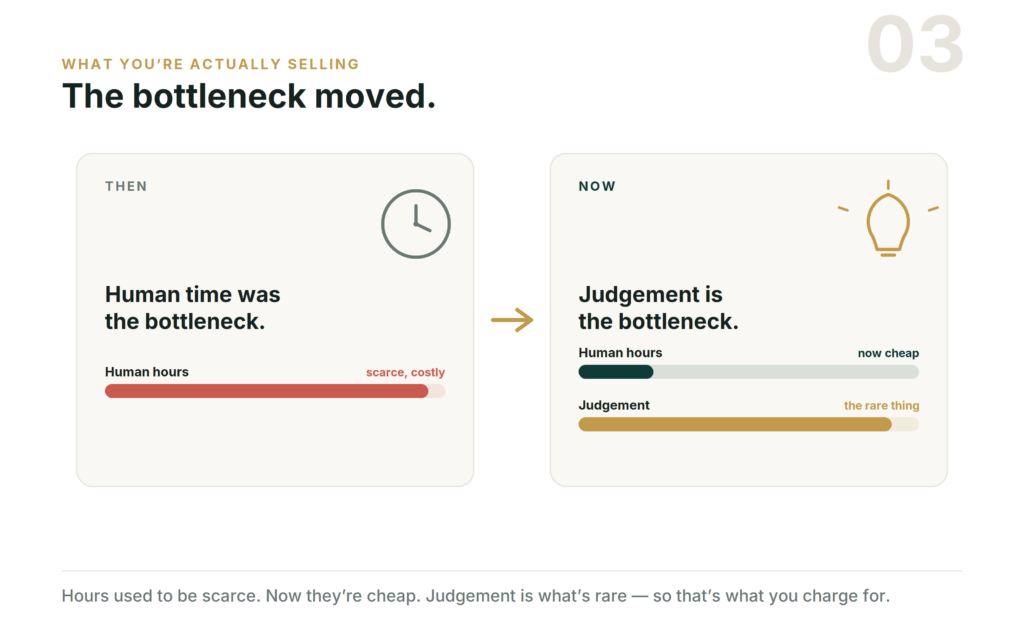
Knowing which 40 hours matter. Knowing which AI output to keep and which to throw away. Knowing why the checkout leaks, not just that it does. Knowing what not to build. Two decades of pattern recognition compressed into the one decision that saves a client six months down the wrong road — that’s the scarce thing now. That’s what clients are actually buying. They were never buying your hours; they were buying the outcome your judgement produces. AI just made it obvious by stripping the hours away.
So charge for the judgement. Charge for the outcome. Stop charging for the hours.
“But what about—”
The objections are fair, so let me take the two big ones head-on.
“What about scope creep?” Fixed price doesn’t mean unlimited work. Scope is the discipline. You define what the package includes, you define what it doesn’t, and anything outside it gets its own quote. Pricing the outcome forces you to get sharp about scope — which is healthy, because vague scope is exactly where hourly projects always quietly bled to death anyway.
“What about genuinely open-ended work?” A small slice of work is true discovery — you honestly can’t scope it until you’ve dug in. Fine: sell a paid discovery sprint as its own fixed package, then price the build once you know what the build is. The point was never that every engagement fits in a neat box on day one. The point is that the clock is the wrong unit to bill against.
The window is closing
This isn’t optional, and the timeline is shorter than most owners want to believe. AI won’t do less of the work next year — it’ll do more. Every month you keep selling hours, the gap between the time you bill and the time you actually spend gets wider. And that gap is either a collapse in your revenue or a crack in your client’s trust. Pick your poison.
Studios that don’t make this shift in the next 18 months won’t exist in 2028. Not because AI replaced them — but because they kept selling the one thing AI made worthless, while their competitors learned to sell the one thing it made priceless.
Charge for judgement. Charge for outcomes. Stop charging for hours. Check Onyx Pricing page.