The Redesign ROI: Measuring the Impact of a UX Overhaul on CAC in WealthTech

Financial technology institutions, particularly those operating within enterprise wealth management and premium robo-advisory sectors, frequently view user experience updates through an aesthetic lens. This perspective represents a costly strategic miscalculation. In high-stakes financial environments, design is not a cosmetic layer; it is a primary driver of financial efficiency.
Customer Acquisition Cost (CAC) in premium fintech sectors remains notoriously high due to prolonged decision-making cycles and complex onboarding requirements. When an investment platform suffers from friction, marketing expenditure is effectively wasted on users who abandon the application before funding their accounts. By reframing user experience as a direct financial lever, organisations can understand how a meticulous structural overhaul directly minimises customer acquisition costs whilst simultaneously improving critical performance metrics.
The True Cost of Interface Friction in Premium Fintech
High-net-worth individuals and retail investors alike demand absolute clarity when navigating financial assets. In spite of this, many enterprise wealth management applications remain burdened by fragmented layouts, opaque data presentation, and rigid workflows.

This structural friction manifests directly in platform metrics:
- Elevated Drop-off Rates: Multi-stage onboarding processes that require excessive manual data entry or display ambiguous compliance mandates trigger user fatigue.
- Prolonged Time-to-Value: If a user cannot ascertain how to execute a trade, review portfolio allocations, or transfer capital within the first few minutes, the perceived utility of the platform diminishes.
- Increased Support Overhead: Poorly designed interfaces force users to rely on customer support channels for basic operational tasks, driving up administrative costs.
When a wealthtech platform fails to guide a user seamlessly from initial registration to account funding, the capital invested in acquiring that user via digital marketing or institutional channels is entirely lost. Consequently, the effective CAC escalates.
Translating Wealth Management App Redesign into Hard Financial Metrics
To justify the capital expenditure of a comprehensive design overhaul, product leaders must link interface enhancements directly to financial performance indicators, specifically CAC and Average Order Value (AOV). A methodical wealth management app redesign mitigates user drop-off by removing cognitive barriers at critical conversion points.
Streamlining Compliance and Digital Onboarding

The onboarding sequence for any wealth management platform is governed by stringent regulatory mandates, including Know Your Customer (KYC) and Anti-Money Laundering (AML) protocols. This phase is traditionally the most significant point of friction.
A sophisticated UX architecture restructures these legal prerequisites into digestible, progressive disclosure stages. By utilising clear visual hierarchies, contextual tooltips, and real-time validation of identity documents, the system reduces the cognitive load imposed on the user. When the onboarding sequence is intuitive, completion rates rise, directly lowering the cost per acquired customer.
Optimising Asset Allocation Through Micro-Interactions
Once onboarding is achieved, the next critical conversion milestone is the initial capital deposit and subsequent asset distribution. Complex investment portfolios often overwhelm users with dense tables and ambiguous terminology.
Replacing static forms with dynamic, interactive elements alters this experience. For instance, micro-interactions implemented during asset allocation—such as responsive sliders that visually demonstrate the real-time shift in risk profile versus projected yield—provide immediate clarity. When users comprehend the structural balance of their prospective portfolio, their confidence increases. This psychological certainty translates to a higher propensity to commit capital, driving an immediate increase in AOV.

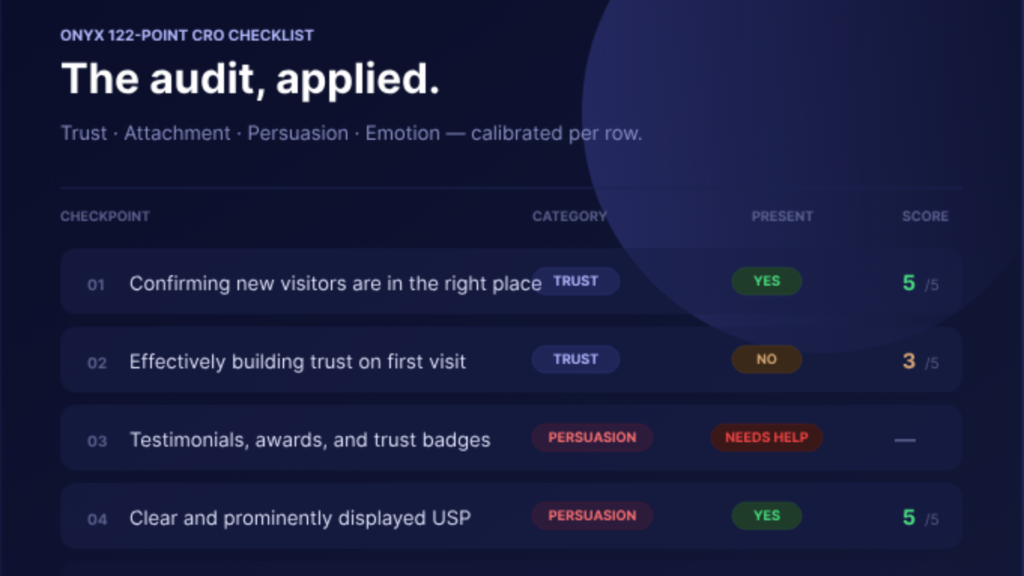
Minimising Market Risk: The 122-Point UX Audit
Executing a successful platform transformation requires more than subjective design preferences. It demands a rigorous, empirical approach to isolate and rectify systemic interface failures. Enterprise organisations benefit significantly from a structured, multi-point evaluation framework to identify exactly where capital leakage occurs.
A comprehensive 122-point UX audit systematically evaluates a wealthtech platform across three critical dimensions:
- Discovery and Functional Mapping
The initial phase involves mapping every prospective user path against defined business objectives. Designers scrutinise the technical architecture of the application to identify redundant steps in the investment funnel.
- Exploratory Friction Analysis
Every interactive element, from typography scaling to menu navigation, is assessed for clarity and responsiveness. In wealth management, information density must be carefully managed; excess data cluttering a portfolio dashboard is flagged as a primary source of user abandonment.
- Testing and Empirical Validation
The final stage subjects the proposed design variations to rigorous usability testing. By analyzing user behaviour during interactive prototyping, engineers ensure that the final build is fully optimised before a single line of production code is written. This data-driven strategy ensures that design modifications are directly correlated with reduced platform drop-offs and enhanced transactional frequency.
A Fintech UX Case Study: Quantifying the Conversion Velocity
The correlation between strategic design and capital efficiency is demonstrated clearly through structured platform optimization initiatives. Consider the consolidation of disparate investment tools into a unified platform. Historically, legacy financial systems operated with isolated applications for equity trading, mutual funds, and portfolio tracking, a fragmentation that forced users to navigate distinct interfaces, multiplying attrition risks.
When these capabilities are integrated into a single, cohesive ecosystem governed by a unified design system, the friction of cross-application navigation is removed. A quantitative analysis of such an optimization reveals predictable performance gains:
| Performance Metric | Pre-Optimization Environment | Post-UX Overhaul Environment |
| Onboarding Completion Rate | Lower due to fragmented compliance steps | Enhanced through progressive disclosure |
| Time-to-First-Investment | Prolonged by ambiguous interface cues | Accelerated via intuitive micro-interactions |
| Customer Acquisition Cost | Elevated by funnel drop-offs | Reduced through efficient user conversion |
| Average Order Value | Constrained by cautious initial capital commitments | Maximised by transparent portfolio visualization |
By accelerating the transition from a prospective lead to an active, investing user, the platform maximises the efficiency of initial marketing expenditures, proving that design efficiency dictates acquisition efficiency.
Conclusion
For enterprise wealthtech providers and premium investment platforms, delaying an interface overhaul under the assumption that design is a secondary concern is an expensive operational error. User experience is a core financial metric that governs whether capital allocation funnels succeed or fail.

A rigorous, data-backed redesign removes the functional friction that drives up customer acquisition costs. By systematically addressing interface deficiencies through an objective auditing process, fintech founders and product strategists can transform complex compliance and asset management workflows into frictionless conversion paths. Ultimately, investing in world-class UX design is a definitive method to reduce fintech CAC, elevate AOV, and secure long-term platform scalability.