Tag

Tag: #UX

UX

The Strategic ROI of Cognitive Minimisation in Enterprise UX

June 25, 2026 3 min read

Modern enterprise platforms frequently compromise operational efficiency by overwhelming the finite capacity of human working memory with excessive feature density and fragmented visual structures. To mitigate this issue, digital product teams must systematically eliminate extraneous cognitive load through the strategic application of disciplined visual hierarchies and standardized design systems. This methodology transforms complex corporate workflows into predictable, intuitive routines, allowing users to dedicate their complete attentional bandwidth to primary business objectives rather than interface navigation. Furthermore, this psychological framework must be supported by empirical user experience research and flawless technical execution, as system latency directly disrupts thought continuity and increases user fatigue. Ultimately, designing interfaces that respect human cognitive limitations is a critical commercial directive that yields higher task completion rates, superior user retention, and diminished operational overheads.

Read article →
UX

The Redesign ROI: Measuring the Impact of a UX Overhaul on CAC in WealthTech

June 23, 2026 5 min read

Enterprise technology platforms frequently face a critical operational risk when complex commercial objectives fail to align with the practical requirements of the end user. This technical misalignment manifests as functional friction, forcing corporate leadership to absorb inflated customer acquisition costs and diminished user retention rates. To mitigate this market vulnerability, sophisticated digital architecture must be treated not as a superficial aesthetic layer, but as a primary financial driver. By implementing a rigorous methodology that transitions systematically from deep stakeholder discovery and market trend analysis to low-fidelity wireframing and high-fidelity interactive prototyping, organisations can effectively insulate their digital assets against market risk. When intricate user interfaces, robust mobile applications, and web platforms are engineered through a data-driven strategy encompassing thorough discovery, empirical exploration, and exhaustive testing, the resulting platform ensures scalability, velocity, and security. Ultimately, this meticulous approach to user experience design removes the cognitive barriers that impede transaction velocity, transforming a digital product from a standard service offering into a market-leading asset that delivers measurable returns on investment.

Read article →
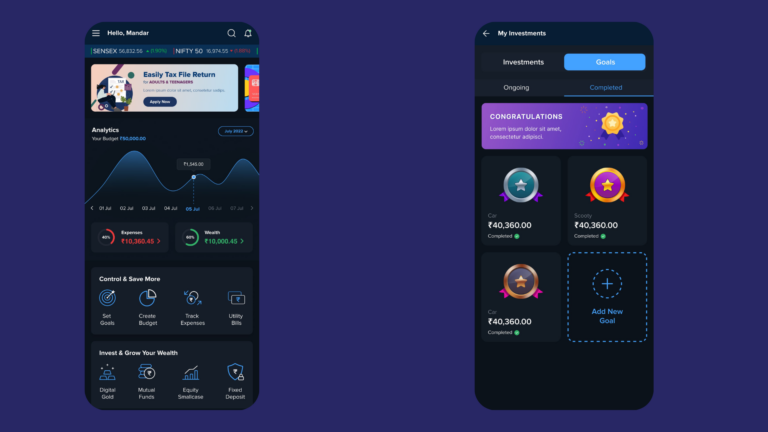
Two mobile app screens showcasing a dark-themed fintech interface side-by-side. The left screen displays a comprehensive home dashboard featuring a market ticker, a promotional banner for tax filing, a dynamic line chart for budget analytics, expense versus wealth tracking rings, and categorized quick-action icons for budgeting and investing. The right screen presents a 'My Investments' interface focused on the 'Goals' tab, displaying a celebratory banner and gamified achievement badges—such as bronze, silver, and gold medals—for completed financial milestones like purchasing a car and a scooty, along with a dashed card to add a new goal.
Arabic UX

Why FinTech UX Design Is the Real Key to Faster SAMA & DFSA Approval

June 20, 2026 4 min read

The perceived trade-off between regulatory compliance and user conversion is a myth that frequently stalls product launches. Treating regulations as an afterthought often leads to rejected designs and rebuilt KYC flows, stretching launch timelines from three months to nearly a year. However, by adopting a regulatory-native approach to FinTech UX design, founders can embed pre-vetted compliance patterns from day one, accelerating approvals from bodies like SAMA and the DFSA to just 2–3 weeks. This strategy is especially critical in GCC markets, where an Arabic-first localization process and clear, Shariah-compliant interfaces turn upfront disclosures into powerful trust signals rather than points of friction. Ultimately, designing for transparency proves that regulatory requirements are actually growth levers, with real-world data showing that clear, progressive disclosures significantly boost user engagement and conversion rates.

Read article →
A professional team collaborating on a fintech ux design project in a modern high-rise office overlooking the Dubai skyline at sunset, reviewing app wireframes on a large curved monitor and table layouts.
Arabic UX

FinTech UX Design for Regulators: SAMA & DFSA Approval in 2–3 Weeks, Not Months

June 18, 2026 3 min read

FinTech startups often lose months in regulatory back-and-forth with bodies like SAMA and DFSA because design and compliance are treated as separate stages. Building compliance into the UX from day one — pre-approved interaction patterns, progressive KYC disclosure, transparent fee and risk displays — flips that. Lending platform Upwards cut application time by 40% and passed regulatory review on the first try; similar approaches lifted investment conversion by 45%. The takeaway: regulatory-native design isn't a constraint on user experience, it's a growth lever. Across lending, wallets, wealth management, and B2B FinTech, compliance-first design speeds up launches and builds real user trust.

Read article →
Premium digital dashboard design demonstrating minimal cognitive load and optimal interface architecture for high conversion rates.
Arabic UX

Designing for Compliance: Optimising Conversion Rates in Shariah-Compliant FinTech

June 16, 2026 3 min read

This article examines how Islamic financial technology platforms can synthesise regulatory compliance with high conversion rate optimisation. By implementing an Arabic-first user experience and utilising pre-vetted interface design systems, product founders can navigate the scrutiny of authorities like the Saudi Central Bank. The methodology demonstrates that absolute transparency regarding Shariah frameworks and fee structures reduces cognitive load and interaction cost. Consequently, integrating compliance natively into the digital product development workflow accelerates time to market, minimises regulatory rejection risk, and enhances long-term customer lifetime value within premium Middle Eastern markets.

Read article →
UX

Maximising Digital ROI: The Strategic Value of Cross-Platform UX Harmonisation

June 13, 2026 4 min read

The contemporary enterprise operates across a fragmented digital landscape, requiring seamless user experiences across iOS, Android, and web frameworks. Enforcing absolute visual uniformity often impairs usability by ignoring platform-specific behaviours. True cross-platform consistency requires functional harmony, where core branding, workflow logic, and user psychology remain unified whilst interfaces adapt to native technical constraints. By establishing platform-agnostic design systems rooted in data tokens, organisations mitigate operational fragmentation and accelerate development cycles. This strategic approach ensures digital products feel intuitive to the platform user, ultimately protecting market share and securing long-term customer loyalty.

Read article →
A professional team at collaborates around a large interactive digital touch table displaying mobile interface prototypes, referencing whiteboards with user experience wireframes in a modern office.
UX

High-Fidelity Prototyping: Eliminating Ambiguity in Software Engineering

June 9, 2026 2 min read

Relying on static documentation during software development introduces ambiguity, resulting in costly technical debt and project delays. Onyx UX Studio mitigates these structural risks by employing a rigorous, design-first methodology centred on high-fidelity prototyping. By translating abstract stakeholder requirements into precise, interactive simulations prior to coding, the studio establishes a definitive technical blueprint. This analytical approach validates architectural feasibility, eliminates engineering guesswork across complex sectors like FinTech and EdTech, and protects capital investments. Ultimately, interactive prototyping ensures total cross-functional alignment, accelerating time-to-market whilst delivering scalable, secure, and highly validated digital products.

Read article →
A realistic, wide-angle photograph of a man sitting at a wooden desk in a brightly lit home office, working on a large computer monitor. The monitor displays a clean, blue-and-white website wireframe and user flow blueprint, illustrating digital information architecture. On the desk in the foreground are physical architectural blueprints rolled up and laid flat, alongside a small architectural model of a multi-story building, visualising the parallel between physical and digital structure. The man is smiling slightly as he looks at the screen, with his hands resting on the keyboard and mouse.
Web 3.0 UX

Beyond Aesthetics: The Critical Role of Information Architecture in Web Platforms 

June 6, 2026 4 min read

The ultimate commercial success of an enterprise web platform relies significantly less on its visual aesthetics than on the structural validity of its foundational architecture. Onyx UX Studio addresses this reality through a rigorous, data-driven methodology that segments the product lifecycle into three distinct, non-negotiable phases: discovery, exploration, and testing. By executing empirical user research prior to any engineering investment, the studio systematically validates product hypotheses against objective market data. This disciplined approach effectively eliminates development redundancies, ensures cross-platform scalability, and protects capital by neutralizing market risks before a single line of code is written.

Read article →
Photorealistic wide view of a cluttered, dimly lit server room containing a mix of old beige computer towers on the left and modern black server racks on the right, filled with tangled network cables and glowing green LED lights under a single hanging lightbulb.
UX

The Blueprint of Digital Transformation: Moving from Legacy Systems to Modern UX

June 4, 2026 4 min read

This article outlines a strategic blueprint for digital transformation, addressing how corporations can successfully migrate complex legacy software into modern, user-centric interfaces. Entrenched system inertia often generates operational friction and high maintenance costs, which businesses can mitigate through a design-first methodology. By executing a data-driven discovery phase, organisations can map existing workflows and validate insights empirically. Utilizing advanced design systems, low-fidelity wireframes, and interactive prototypes ensures functional clarity before engineering begins. Ultimately, the framework delivers secure, scalable backend architectures that integrate seamlessly with legacy data, driving long-term corporate agility and institutional adoption.

Read article →

Latest from the Onyx UX Blog

View all articles →