User-Centricity in EdTech: Balancing the Needs of Instructors and Learners

The rapid digitisation of education has necessitated a shift from basic online repositories to highly complex, multi-portal digital ecosystems. Within these platforms, diverse user groups interact simultaneously, each requiring distinct functional environments. Educational technology platforms are no longer merely administrative tools; they are primary venues for knowledge transfer, assessment, and institutional management.
Achieving true user-centricity in this sector presents a unique challenge, as design architectures must accommodate two primary, often conflicting, user archetypes: the instructor and the learner. While learners require minimalist, low-friction interfaces that facilitate focus and cognitive retention, instructors demand robust, information-dense control panels to manage curriculum delivery, grading, and student analytics. Designing a harmonised system that caters to both groups without compromising platform performance or usability requires a rigorous, strategic approach to user experience design.

The Friction of Divergent User Archetypes
In traditional enterprise software, a single user profile typically dominates the system architecture. In educational technology, however, the platform must serve asymmetric workflows with equal efficacy.
The Learner Profile
The contemporary learner expects a seamless, highly intuitive digital environment. Cognitive load theory suggests that unnecessary interface complexity directly detracts from a student’s capacity to process and retain educational content. When a student struggles to locate an assignment link or decipher an ambiguous navigation menu, cognitive resources are diverted from learning to interface troubleshooting. Therefore, the learner portal must prioritise clarity, progressive disclosure, and mobile responsiveness, ensuring that the educational content remains the focal point of the experience.

The Instructor Profile
Conversely, the instructor operates as a power user. Their workflows are transactional, repetitive, and data-heavy. Instructors use the platform to build curricula, assess submissions, track performance metrics, and communicate with institutional administrative staff. A simplified, minimalist interface that benefits a student often frustrates an instructor by hiding critical actions behind nested menus or slowing down batch operations. Instructors require high data density, customisable dashboards, and powerful automation tools to manage their daily responsibilities efficiently.
The central challenge for product designers lies in preventing the feature-rich requirements of the instructor portal from bleeding into the learner environment, whilst ensuring that both portals operate on a unified data layer.
Methodologies for Harmonised Multi-Portal Systems
To construct a balanced, multi-portal EdTech platform, design teams must employ specific UX methodologies that isolate user workflows while maintaining systemic cohesion.

Role-Based Architecture and Interface Bifurcation
The foundational step in mitigating friction between user groups is the implementation of strict role-based access control coupled with interface bifurcation. Rather than attempting a compromise that partially satisfies both parties, designers should create distinct frontend experiences tailored to each role, supported by a shared design system.
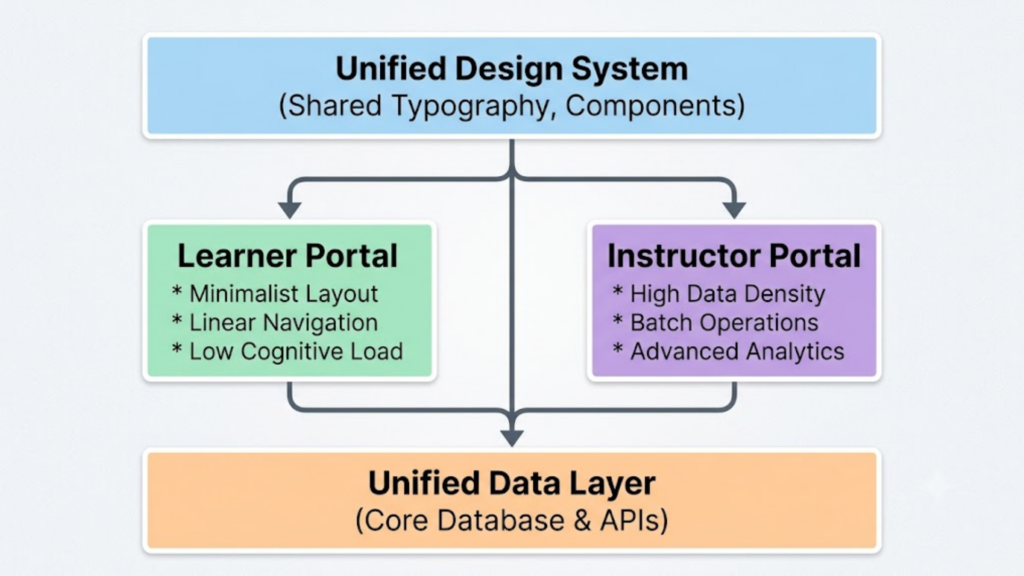
The learner portal should utilise a linear layout, guiding the student through their coursework sequentially. Micro-interactions should be celebratory but subtle, providing positive reinforcement without causing distraction.
The instructor portal, by contrast, should adopt a modular layout. Dashboards should leverage grid systems that allow educators to reconfigure data components based on their current priority, whether that involves reviewing urgent submissions or evaluating term-wide performance analytics.
Information Architecture and Progressive Disclosure

Managing information density is critical when designing for instructors. To prevent cognitive fatigue among educators, systems must employ progressive disclosure: a design technique where necessary information is presented initially, while more complex or secondary data remains hidden until explicitly requested.
For example, when an instructor views a class roster, the top-level view should display only essential metrics, such as student names, current averages, and attendance rates. Detailed behavioral data, historical grade trends, and communication logs should reside within secondary, expandable layers. This approach preserves the data density required for comprehensive evaluation without overwhelming the user during routine navigation.
Consistent Design Systems and Inter-Portal Predictability
Although the portals serve different functions, they must remain parts of a single, cohesive ecosystem. Maintaining a unified design system ensures that the visual language, typography, and core UI components remain consistent across both environments. This consistency is particularly vital for hybrid users, such as graduate teaching assistants, who transition frequently between learner and instructor roles. A shared visual vocabulary reduces the learning curve and fosters institutional trust.
Validating the Dual-User Ecosystem
Given the complexity of multi-portal systems, a data-driven validation strategy is required to ensure that the platform effectively balances the needs of both user segments. Product teams should execute research in three distinct phases.
- Discovery: Conduct qualitative interviews and contextual inquiries with both students and faculty members. This phase identifies the distinct pain points, environmental constraints, and technological proficiencies of each group.
- Exploration: Develop low-fidelity wireframes to map user journeys independently. Testing at this stage ensures that the separation of workflows is logical and that user journeys do not conflict.
- Testing: Deploy high-fidelity interactive prototypes to both user groups simultaneously. Designers must measure success metrics independently, evaluating completion rates for students submitting assignments alongside time-on-task metrics for instructors grading those same submissions.
This rigorous testing cycle minimizes market risk and guarantees that optimizations made for one user group do not inadvertently degrade the experience of the other.
Structural Harmony in Educational Design
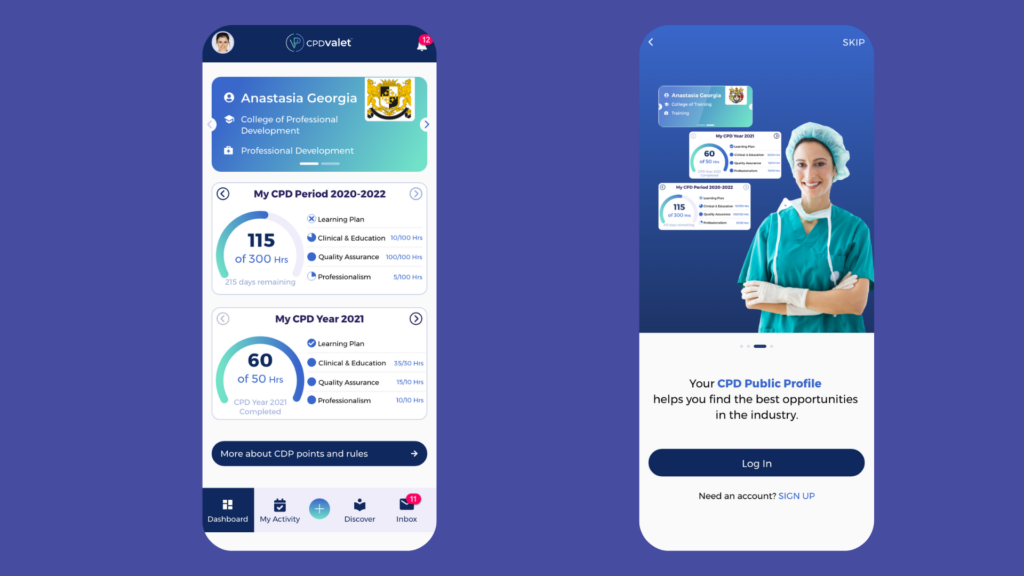
The success of an educational technology platform depends on its ability to serve instructors and learners with equal precision. By acknowledging the fundamental differences in how these two groups interact with technology, design teams can create multi-portal systems that eliminate operational friction.
Balancing minimalist design for students with robust data density for educators creates an environment where technology enhances the educational process rather than obstructing it. Ultimately, user-centricity in EdTech is achieved not through compromise, but through the deliberate, structured separation of workflows supported by a unified architectural foundation.